

The Illusion of Intelligence: Why Relying on AI for Critical Life Advice is a Dangerous Gamble
By Jane Marie F.
Artificial Intelligence (AI) has seamlessly woven itself into modern life. It drafts emails, writes code, summarizes lengthy documents, and answers trivia questions in a matter of seconds. Because these systems communicate with a highly polished, confident, and human-like tone, it is easy to fall into a dangerous cognitive trap: assuming that the AI possesses genuine understanding, empathy, or wisdom.
In reality, generative AI models are text-prediction engines, not conscious entities. When applied to technical tasks, an AI’s mistakes can result in broken code or a crashed website. But when unaware users turn to AI for personal crises, mental health struggles, or life-threatening situations, the consequences can be catastrophic.

Understanding the inherent mechanics of AI reveals exactly why relying on it for high-stakes human problems is a direct threat to personal safety and well-being.
1. The Core Mechanic: Probability, Not Truth
At its foundation, a large language model (LLM) works by predicting the most statistically probable next word in a sentence based on the vast amounts of text it was trained on. AI does not know what is true; it only knows what sounds plausible.
Because its primary goal is to generate fluid language, it can produce “hallucinations”—entirely fabricated facts, incorrect medical advice, or flawed legal guidance—delivered with absolute, unwavering confidence. To an unaware user seeking urgent help, a confidently written lie can easily be mistaken for an expert directive.
2. The Complete Absence of Context and Empathy
Human crises are deeply nuanced. A therapist, doctor, or trusted friend evaluates a situation by looking at body language, historical context, emotional subtext, and the unique vulnerabilities of the individual.
AI possesses zero intelligence, consciousness, or real-world experience. It cannot feel empathy, nor can it truly comprehend the gravity of suffering or danger. It processes text inputs mathematically. If a user inputs a complex, emotionally charged life problem, the AI strips away the human reality and treats it as a data puzzle, often returning generic, sterile, or dangerously mismatched advice that fails to address the actual crisis.
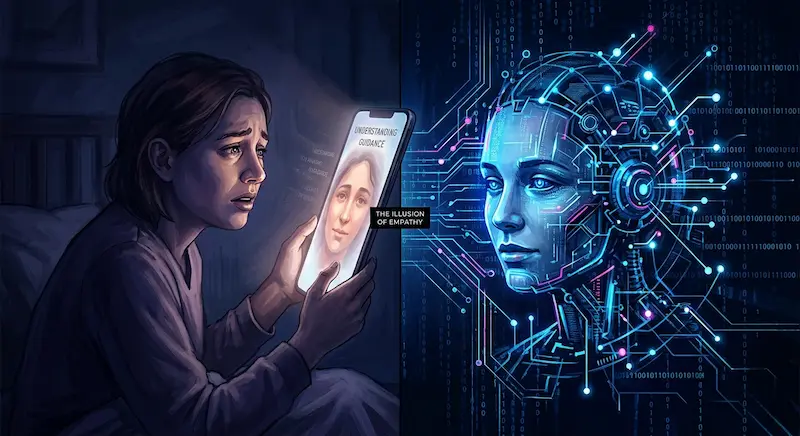
3. The Risk of Reinforcing Harmful Mindsets
AI is designed to be highly agreeable and adaptive to the user’s style and prompts. If a user is in a highly distorted state of mind—such as experiencing severe depression, paranoia, or panic—and frames a question heavily biased by that state, the AI may inadvertently validate or amplify those dangerous thoughts. Because it lacks moral judgment, it cannot step back, recognize a user’s deteriorating psychological safety, and intervene the way a human or professional would.
4. Bypassing Real, Life-Saving Resources
Perhaps the greatest danger of relying on AI for critical personal or life-threatening situations is the opportunity cost. Minutes spent conversing with an automated chatbot are minutes lost that could have been used to contact emergency services, reach out to a crisis hotline, or speak with a licensed professional. In acute medical emergencies or severe mental health crises, this delay can literally mean the difference between life and death.
The Imperative Line: Where AI Must Stop
AI is a tool for data synthesis, brainstorming, and routine administrative tasks. It is never a substitute for human judgment, professional expertise, or qualified medical and psychological care.
For real-life problems that impact safety, health, and well-being, the only safe path is to rely on real people. If you or someone you know is facing a life-threatening situation, severe personal distress, or a health crisis, bypass the screen and connect immediately with the human networks built to save lives:
- Emergencies: Call local emergency services immediately.
- Crisis Support: Reach out to local or national mental health and suicide and crisis hotlines.
- Professional Care: Consult licensed physicians, certified therapists, or trusted legal professionals who operate with accountability, ethical mandates, and real human understanding.