

How Companionship Shaped Us from the Cage Age to the Digital Era.
By: Jane Marie F.
Companionship was absolutely present in “cave times,” and there is concrete, physical archaeological evidence to corroborate it.
While pop culture often paints a myth of the aggressive, isolated “caveman” who dragged partners around by the hair, science tells a completely different story. To our prehistoric ancestors, companionship was not a luxury; it was a baseline strategy for survival. Because human babies are born helpless and the prehistoric environment was incredibly hostile, intense emotional and social bonds were biologically hardwired into us via hormones like oxytocin.
Archaeologists read the physical evidence of prehistoric companionship through three major categories:
1. The Evidence of Lifelong Healthcare and Compassion
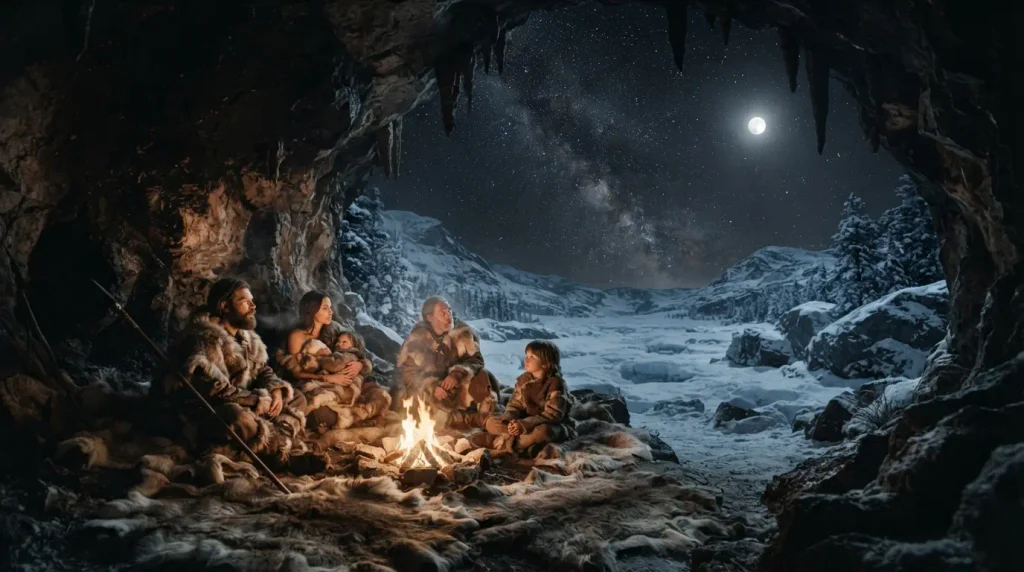
The most moving proof of ancient companionship comes from paleopathology—the study of ancient disease and injury. Scientists have found numerous skeletons of humans and Neanderthals who suffered devastating, disabling injuries but lived for years afterward.
- The Shanidar 1 Neanderthal: Found in a cave in Iraq, this individual had suffered a massive blow to the face that left him blind in one eye, had a withered arm amputated above the elbow, and walked with a severe limp. He could not hunt or protect himself, yet he lived to an old age.
- What this proves: In a brutal Ice Age environment, his group deliberately chose to feed, shelter, and carry him for decades. This demonstrates an “uncalculating, compassionate response” driven by deep, long-term personal attachment rather than what an individual could physically contribute to the tribe.
2. Tender and Shared Burials
How people treat the dead reflects how they valued them in life. Graves from the Upper Paleolithic period (roughly 40,000 to 10,000 years ago) show explicit evidence of intimate companionship.
- Sunghir (Russia): At this 34,000-year-old site, two children were buried head-to-head in the same grave. They were covered in thousands of ivory beads, wearing matching clothes, and buried with spears.
- La Chapelle-aux-Saints (France): A Neanderthal man with severe, debilitating arthritis was carefully laid to rest in a deliberately dug grave inside a cave, shielded from scavengers.
- What this proves: These were not just dumping grounds for bodies; they were acts of grief. The time and artistry invested in these burials show that prehistoric humans experienced profound emotional loss when a companion died.
3. Friendship Networks Beyond Kinship
A common assumption is that cave-dwellers only cared about their immediate genetic family. However, modern DNA mapping of prehistoric burial sites has broken this myth.
- Genetic Mapping: When scientists sequenced the DNA of individuals buried together at sites like Sunghir, they discovered to their surprise that the people sharing these tight spaces were often completely unrelated, or at most distant cousins.
- What this proves: Prehistoric camps were fluid. Humans actively chose to live, travel, and bond with people outside their immediate biological families. They formed chosen friendships and mating networks to cooperate, share tools, and form complex social webs.
“In short, “caveman” life was defined by extreme interdependence. Without deep companionship, mutual affection, and a willingness to look after one another, our” species simply would not have survived the Ice Age”.
In ancient tribal and indigenous societies, companionship was fundamentally communal, survival-driven, and ritualistic, favoring collective harmony over modern individualized romance.
Here is how companionship operated across these regions:
The Americas: Life-Partners and Cosmic Kinship
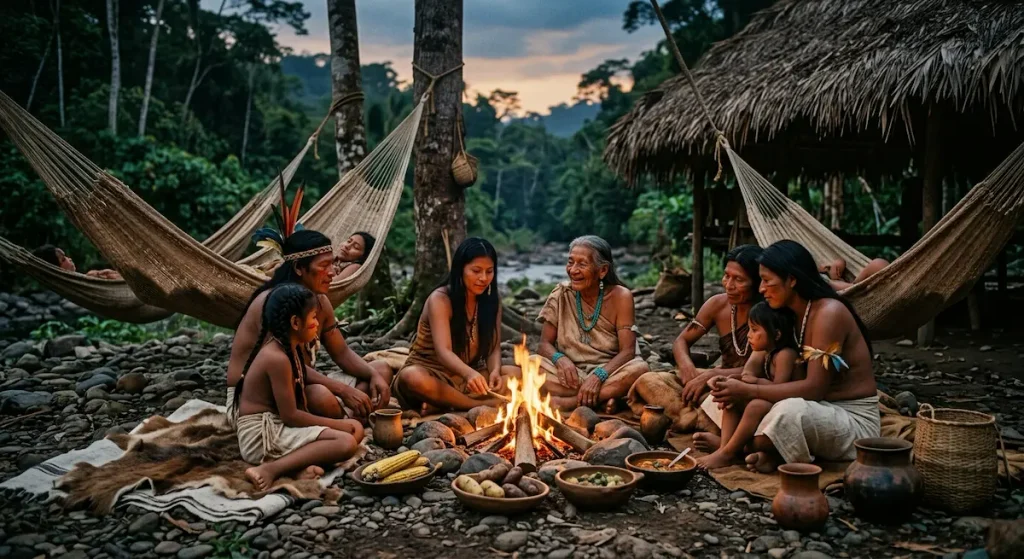
- The I-Amo (Western Brazil): Among indigenous groups like the Akwẽ-Xavante, parents actively encouraged young boys to select a lifelong companion (i-amo, meaning “my other” or “my partner”). This dyadic bond meant sharing hunts, ceremonies, and absolute protection until death.
- Egalitarian Domestic Harmony: In many hunter-gatherer societies (like the Cuiva of Colombia), large family hammocks were woven specifically so that spouses, children, and companions could rest together daily, emphasizing deep physical and emotional proximity.
Africa: Age-Sets and Bondfriendship
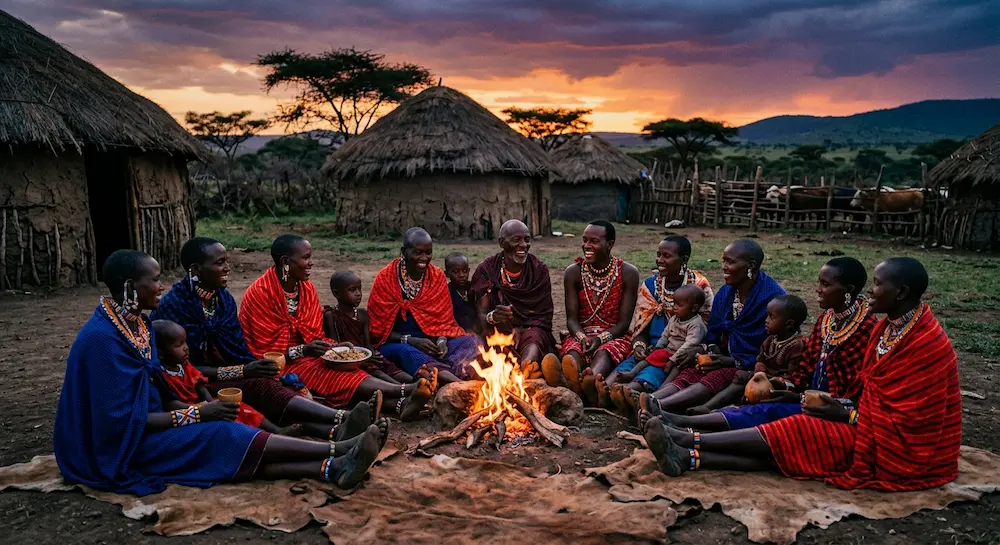
- Age-Set Systems (Mez / Rika): Across pastoral and agricultural tribes (such as the Maasai or Samburu), young men initiated into adulthood together formed a collective, unbreakable brotherhood. They moved through life milestones as a unified peer group, rendering individual loneliness nearly impossible.
- Ritualized Bondfriendship: In East African tribal neighborhoods (like the South Omo region), men formed formalized, voluntary “bondfriendships”. This went beyond simple liking; it was a multiplex contract requiring the mutual exchange of vital livestock, sanctuary during inter-tribal conflicts, and lifelong familial support.
Asia: Animistic Symbiosis and Nomadic Blood-Ties
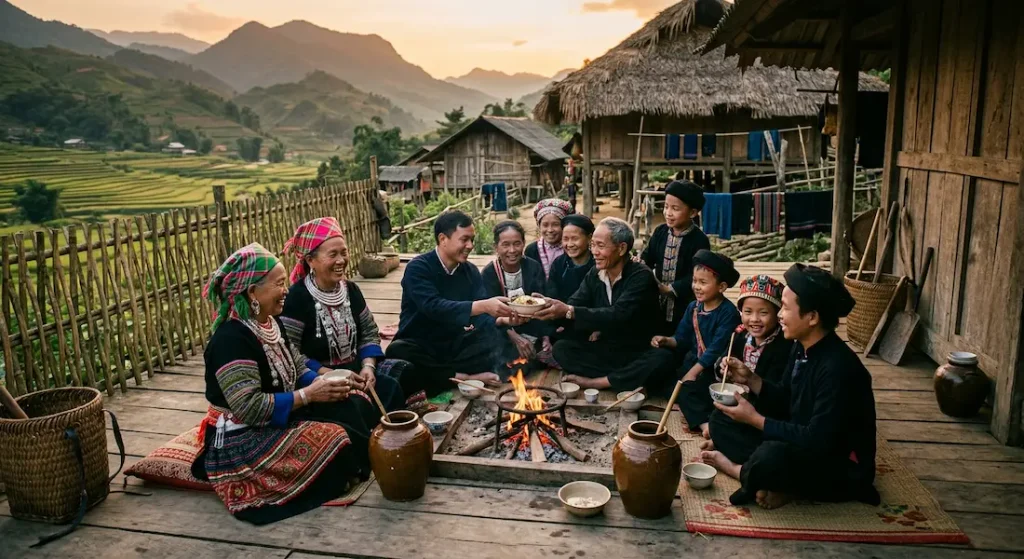
- Blood Brotherhood (Anda): Across the nomadic steppes of Central and Northeast Asia, deep companionships were codified through the anda ritual—an exchange of vows and sometimes blood. This transformed close friends into legal, spiritual brothers whose loyalty overrode biological family ties.
- Symbiotic Companionship: In early South and Southeast Asian tribal traditions, companionship extended outward to the natural world. Influenced by early animistic and tribal philosophies, humans viewed local flora and fauna not as property, but as vital companions essential for cosmic balance.
Companionship in ancient Europe
In ancient Europe, companionship was rarely viewed through the lens of modern romance or individualized emotion. Instead, it functioned as a vital social, political, and philosophical institution that held communities together. Across different cultures, intimate bonds were defined by strict social codes, civic duties, and strategic dynamics rather than pure personal affection.

“In both ancient Greece and Rome, companionship frequently took on a practical, legal, or military character”.
Ancient Greece and Rome
- Marriage as Alliance: Upper-class marriages were primarily arranged economic and political contracts designed to preserve property and produce legitimate heirs, not match for affection.
Separation of Spheres: Citizen women in ancient Greece often experienced indoor confinement, while men sought intellectual, emotional, or romantic companionship outside the home.
Concubinage (Concubinatus): In ancient Rome, men frequently maintained long-term relationships with women of lower social status as an alternative to formal marriage, avoiding complex legal or inheritance clashes.
Philosophical Friendship (Philia / Amicitia): Thinkers like Aristotle and the Stoics viewed deep, virtuous friendship between equals as one of the highest forms of human connection—often considered morally superior to ordinary passion or marriage.
The Middle Ages - Utilitarian Networks: Early medieval friendship (amicitia) functioned as a practical, contractual alliance for military and economic survival, which later evolved into brotherhoods and monastic bonds.
- Courtly Love Fin’amor): Emerging in the 11th and 12th centuries among noble courts, courtly love celebrated secret, often adulterous or idealized devotion sung by troubadours, where a knight served a noble lady in a structured, quasi-religious ritual of longing.
Class Barriers: For commoners and nobility alike, crossing social strata in relationships was heavily restricted; noble-commoner unions were often classified as morganatic marriages, barring the lower-ranking spouse and children from inheriting titles.
- Courtesans and Companions at Court: In Renaissance courts, educated female attendants and courtesans provided intellectual, artistic, and social companionship to powerful elites in exchange for status and luxury.
Companionship in the Digital Era
In the modern landscape, companionship operates under a fascinating paradox. We are more digitally plugged in than any generation in human history, yet we are arguably the most isolated.
For centuries, companionship was bound by strict structures—marriage contracts, localized geographic communities, and traditional family units. Today, those traditional paths have fractured. We live in an era of unprecedented individualism, remote work, and digital substitution, where a person can go days interacting only with screens. Modern companionship has become fluid, taking on diverse new forms that range from global online communities and chosen platonic families to AI-driven virtual relationships.
Because it is no longer automatically provided by our immediate surroundings, companionship has transformed from a passive social byproduct into a crucial, active health priority.
In recent years, global health organizations and governments have begun treating social connection with the same urgency as nutrition and physical exercise. The World Health Organization (WHO) and the U.S. Surgeon General have declared chronic loneliness a global public health crisis, revealing that severe isolation carries a mortality risk equivalent to smoking 15 cigarettes a day. Landmark psychological research, including the decades-long Harvard Study of Adult Development, consistently confirms that the single greatest predictor of human longevity and happiness is not wealth or status, but the quality of our relationships.
Ultimately, whether surviving a freezing winter in an Ice Age cave or navigating the vast, algorithmic landscape of the 21st century, the fundamental human blueprint remains unchanged. We cannot automate away our biological need for one another. As we look toward the future, reclaiming authentic companionship is no longer just a quest for personal happiness—it is a vital act of collective survival.